Freediving Deep Blackout: The Day a Diver Almost Didn’t Come Back


AIDA & Molchanovs Instructor Trainer
He is the founder of The Depth Collector and VD Freediving Taiwan. With over a decade of experience, he focuses on solving real-world freediving problems, from equalization to depth adaptation, using practical, field-tested methods.
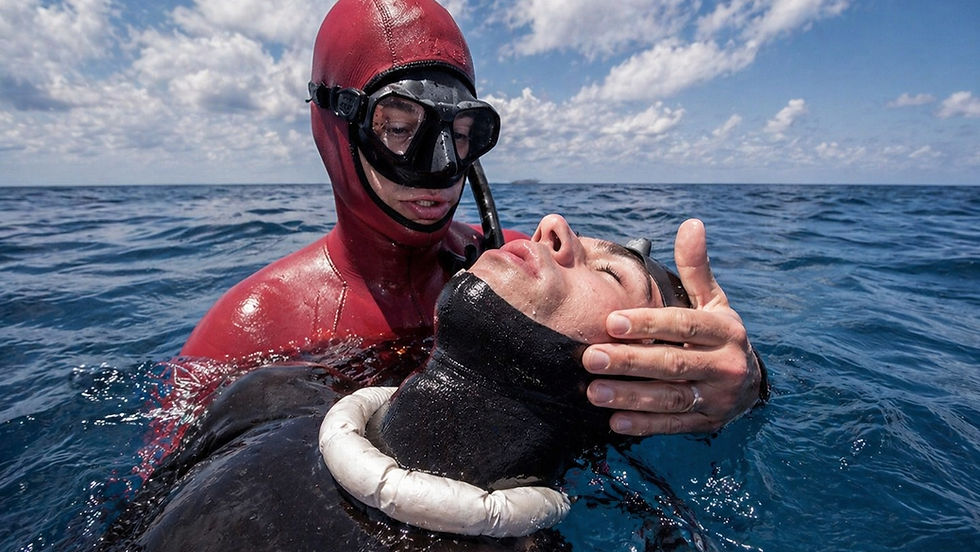
We were doing a boat dive that day, in Xiaoliuqiu. And when we take the boat out here, it usually means one thing: we’re going deep. Otherwise, we stay close to shore.
I had three Master students on my buoy. Jiayin had the same. Just another day in our office. Blue water, around 25 meters of visibility, flat conditions, sun out… the perfect day.
On another buoy, there were three former students. They had completed their Master program with us about six months earlier and came back for the weekend to train on their own. For most of them, it was their first real session back in the water.
“M” was there, sharp and full of energy as usual. And “K”… well, K is… you’ll understand soon enough.
I finished my session and got back on the boat with my students. I was sitting there, eating watermelon. Yeah, we always have fresh watermelon on the boat. Sometimes guava. Depends on the day.
That’s when I saw M.
She was towing K back to the boat, calling for help.
He was unconscious.
We pulled him onto the boat and immediately started the rescue procedure. M told us she had picked him up around 15 meters.
A few seconds passed.
Then he gasped.
Started breathing again.
Blackouts happen in freediving. They’re part of the sport, even if we do everything we can to avoid them.
But this one… this one should not have happened.
We put him on oxygen. He was pale. Completely drained.
Then he started coughing.
Blood.
Mouthfuls of it.
And then, strangely, he laughed.
Maybe it was a defense mechanism. Maybe he had no real idea what had just happened. When you blackout, you kind of switch off. You don’t remember much. You just come back.
But he clearly wasn’t processing it yet.
He came very, very close to something much worse.
Not just for himself.
But for M as well.
The Training Was There
Our Master Program at VD Freediving is, in my opinion, one of the best in the world. It’s ten days designed to give someone everything they need to start diving deep, comfortably and safely. One full day is dedicated to safety and rescue, and we cover both the theory and real-life scenarios that actually happen on a line.
We start with the basics: the gear, the buoy's color, why a whistle is mandatory, the flag, the dive line that must sink, how to mark it, and why it must stay under tension. We explain the pulley system and the maximum bottom weight you can use if you’re not using a counter-ballast.
Then we go deeper into safety timing, where to meet the diver, and how depth, dive time, and safety all connect. I’ve applied these methods while doing safety for the deepest divers, and they work.
And we insist on one thing: as a safety diver, you are always prepared for the worst-case scenario.
The diver who ended up spitting blood that day had taken that course. A year later, he admitted it himself: he hadn’t really listened. Lucky for him, M had.
Every student is different. Some forget details, and that’s normal. Not everyone has the chance I have to spend years thinking about freediving every single day.
But K was different. I had never seen someone so focused on numbers and depth that he forgot everything else. I had never had a student so convinced he already knew enough that he stopped learning, stopped listening altogether.
And that day, chasing a new PB, he didn’t make one mistake. He made a cascade of them, each one avoidable if he had just switched his brain back on.
The Essential Freediving Rules He Ignored
He broke the basics. One after the other.
Respect your current level.
If your last deep dive was months ago and you haven’t trained since, you don’t come back and repeat it straight away. You start shallower and work your way down progressively.
And you definitely don’t go deeper right away.
Don’t make a big jump in depth.
50 meters does not become 60 overnight.
Progress takes time.
Your body, your nervous system, and your mind all need to adapt.
Be rested for a PB.
You don’t go for a personal best after days of consecutive training, and you don’t place your attempts at the end of a session. A PB happens at the beginning, when you are fresh, not after an hour of random diving.
Your body is tired. Glycogen in your muscles is depleted.
Your nervous system is fatigued.
A personal best is not the time to try something new.
Free immersion is usually done with fins. That’s how we train. Only in competition are fins removed.
Taking them off changes everything. You will be slower, your balance during freefall is different, and without specific practice, you lose efficiency and time.
That’s not something you want to figure out when you’re already at your limit.
Never dive on an open line.
A personal best comes from structured, intelligent training. You don’t just drop the line deeper and hope it works; you build to it, dive by dive, with a plan.
Use the right setup.
A 15 kg competition weight without a ballast is too heavy. If your buddy has to pull you up from depth, those extra kilos don’t just slow things down, they change the entire rescue. Every meter takes more effort, every second counts, and the margin for error disappears.
It doesn’t just make the rescue harder. It makes it dangerous.
Communicate your dive.
If you’re diving deep, you know your dive time. You share it. That’s what allows the safety diver to plan properly, when to leave the surface, how deep to meet you, and how long they can stay with you.
Without that information, there is no real safety plan, just guesswork.
Listen and learn.
More experienced divers see what you don’t, not because they are smarter, but because they have been there before. They have made the mistakes, they have seen things go wrong, and they understand how fast a dive can turn.
If they tell you something, there is a reason. You don’t have to agree with everything, but you listen.
Freediving is always a work in progress, and the moment you think you have nothing left to learn is usually when you are the most at risk.
On that day, K ignored all of it.
Freediving deep blackout: The Day a Diver Almost Didn’t Come Back

That morning, I saw K. pick up the 15 kg competition bottom weight. We use it for the Liuqiu Cup with a counter-ballast system. All the weights look the same, so I understand how the mistake can happen, but this one isn’t meant to be used without a ballast.
I told him, “Not that one. It’s too heavy.” He nodded, but still took it when I wasn’t looking.
We got ready, moved to the harbor, and jumped on the boat. The session started like any other. People got in the water, lines were set, divers disappeared into the blue and came back up. Nothing felt off. Just another training day.
Then fast forward.
I’m back on the boat and I see M towing K.
We get him onto the boat. He’s out, not moving. A few seconds pass, then he gasps and starts breathing again.
So what happened?
It was a calm, easy day. K., M., and two others had already been diving for about an hour. Enough time to build fatigue without really noticing it.
Then K. decides to go deeper than he ever has. 60 meters. His personal best was 50, done once, months ago, with no training since.
He takes his fins off for the first time. He doesn’t know his dive time and doesn’t communicate anything.
His friends try to estimate it: 120 seconds, based on one meter per second. That works when the dive is clean, when the diver is efficient, when everything is controlled.
This dive was none of that.
Free immersion without fins means slower movement, more effort, less control, more time. Add one hour of diving, and fatigue is already there. Timing is off. No communication.
This isn’t a dive anymore. It’s a gamble.
M goes down for safety at 20 meters while another diver stays shallower. She waits longer than expected. The second diver has to come back up, he can’t hold. M stays, then goes deeper, 25… maybe 30 meters, trying to spot K.
That’s when she sees him coming up.
Slow. Too slow.
She has a choice. Go up, or stay. She stays.
She’s deep, under pressure, fighting a strong urge to breathe, but she holds. Locked in. She stays with him and escorts him up until he blacks out around 15 meters, that exactky whata freediving deep blackout is .
She reacts instantly. Grabs him, brings him to the surface, and tows him back to the boat.
Final Line
This story should not have happened, and that’s the problem. This wasn’t bad luck, it wasn’t conditions, and it wasn’t a single mistake. It was a sequence of bad decisions driven by ego.
K had taken the course. He had been shown what to do and what not to do, and he chose not to apply it.
That’s the difference. There are freedivers, and there are risk takers. A freediver trains, adapts, communicates, and respects the process. A risk taker skips steps, chases numbers, and assumes it will work out.
One improves. The other relies on luck. That day, K relied on luck.
M didn’t. She did the job. She went when she had to go, she stayed when most people would have turned, and she held under pressure to make the right decisions when it mattered. That’s what a real freediver looks like, and that’s what kept him alive.
Don’t read this as a dramatic story. Read it as a warning. The line between the two is thin, and it has nothing to do with your depth. It has everything to do with how you dive.


Comments