Freediving Is Safe… Until Suddenly It Isn’t.

In Memory of Leonard Wei-Hung
August 13, 1996 – October 31, 2024

AIDA & Molchanovs Instructor Trainer
He is the founder of The Depth Collector and VD Freediving Taiwan. With over a decade of experience, he focuses on solving real-world freediving problems, from equalization to depth adaptation, using practical, field-tested methods.
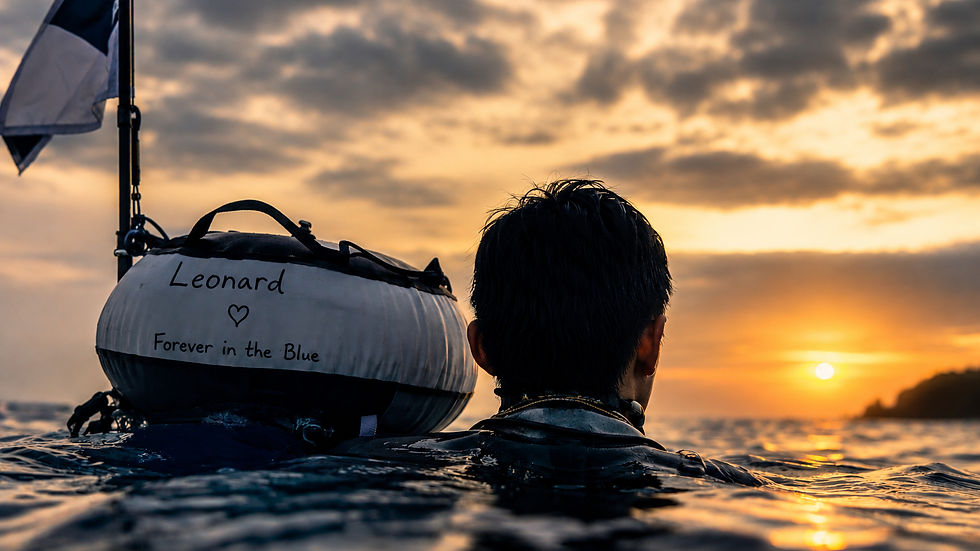
A few years ago, a close friend of mine died while freediving.
I’m still trying to wrap my head around it. The pain is sharp, a relentless mix of anger, sadness, confusion, and disbelief that refuses to let go. I still cannot fully accept that I will never see him again.
Leonard is gone. Just like that.
He was only twenty-eight years old, and his absence leaves behind a hole that nothing can fill.
What makes it even harder to process is how meaningless it feels. All the training. All the experience. All the safety procedures. And still, in a single instant, he was gone.
We tell ourselves freediving is safe. And it is, if we follow the rules. If we dive with competent people. If we respect proper freediving safety protocols and train seriously.
But sometimes reality does not care.
Sometimes there is still room for fate to step in.
And when it does, it feels unstoppable, as if the universe suddenly aligns in the most brutal and indifferent way possible. Now his family, his friends, and everyone left behind are forced to live with questions that will never truly have answers.
Leonard was not reckless.
He was a skilled freediving instructor, a reliable safety diver, and someone deeply respected in the water. The kind of diver people trusted immediately. The kind of person who made others feel calm during deep dives and training sessions.
That is what makes this so difficult to understand.
Freediving Is Safe… Until Suddenly It Isn’t
Moments like this force us to confront the brutal truth about freediving risks.
Freediving is safe, until suddenly it isn’t.
The ocean does not care about our certifications, our experience, our training plans, or how many dives we have completed. The water does not distinguish between our sweat and our tears.
The water decides.
And despite what many experienced freedivers sometimes want to believe, we are never fully the ones drawing the line.
As I once wrote in the introduction of my books, the water gives and takes.
But “takes” is too gentle a word.
Sometimes the ocean tears things away from us.
Violently. Permanently.
And in those moments, it reminds us how temporary all of this really is.
Why We Still Freedive?
And yet, despite all of that, freediving remains one of the most beautiful things I have ever known.
Freediving gives us discovery. Purpose. Friendship. Those electric moments at depth when the entire body feels awake. The dopamine rush of reaching a new personal best. The quiet satisfaction of a clean freefall into the blue.
It gives us unforgettable smiles on the buoy after a good dive.
It gives us those silent moments between divers floating together in open water, sharing stories, exhaustion, excitement, fear, and dreams.
It gives us the sound your safety diver makes in the water as you ascend from the depths, reminding you that you are not alone anymore. The quiet comfort of knowing someone is waiting for you at the surface.
Freediving gives us pieces of ourselves we may never have found otherwise.
But freediving also means standing close to forces far greater than us, pressure, currents, physiology, hypoxia, timing, mistakes, and chance.
It is a constant dance between control and surrender.
And maybe that is the truth we try not to look at too often.
The Reality of Freediving Accidents
Freediving is an extreme sport.
We tell our families it is safe. We tell our students it is safe. We tell ourselves that we know where the limit is, that we know when to stop, that we know when to breathe.
But do we really?
Today, as I mourn my friend, one thing feels painfully clear to me:
For all the beauty freediving has brought into my life, my wife, my purpose, my career, my students, my memories, and my dreams, the sport I love can also, in a single instant, take everything away.


Comments