A Conversation That Never Happened: Jacques Mayol on Dolphins, Freediving and the Art of Letting Go

Jacques Mayol took his own life in 2001, so this conversation never happened. This imagined interview draws on his writings, documented interviews, and accounts from those who knew him, but the answers are fictional. Inevitably, they are also shaped by what I would have liked him to tell me. Mayol was a complicated man, full of contradictions, and I make no claim to know what he would actually have said. What follows is simply my attempt to imagine a conversation with someone who changed freediving forever and deeply influenced my own relationship with the ocean.
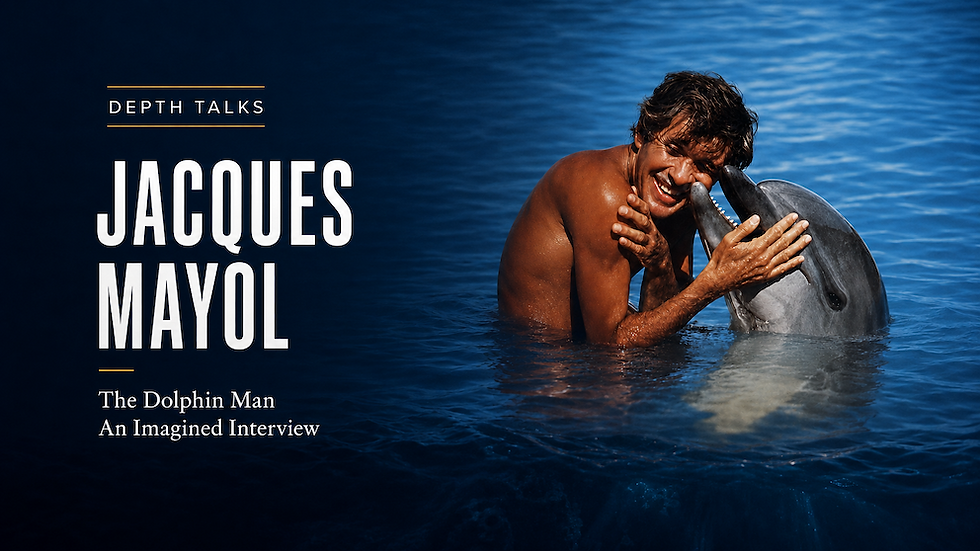
Some people change a sport by breaking records. Others change it by making everyone reconsider what the sport actually means.
Jacques Mayol did both.
In 1976, he became the first freediver to reach 100 meters on a single breath. At the time, many people believed such a dive was physiologically impossible. Seven years later, at the age of 56, he reached 105 meters.
But Mayol’s influence extended far beyond those numbers. He introduced yoga, relaxation and a profoundly personal relationship with the ocean into a discipline often defined by strength and competition. He studied dolphins, worked with scientists and spent much of his life exploring the connection between human beings and the sea.
He was also one of the inspirations behind The Big Blue, the film that introduced generations of people to freediving.
I never had the opportunity to meet Jacques Mayol. But if I could sit down with him today, preferably somewhere quiet, facing the ocean, this is how I imagine our conversation might unfold.
The First Time He Met a Dolphin
Anthony: Jacques, before the records, before The Big Blue, before everyone started calling you the Dolphin Man, where did your relationship with the ocean begin?
Jacques: In several places, I suppose. I was born in Shanghai, but my family spent summers in Japan. My brother and I explored the coastline, the caves and the water around Karatsu.
For children, the sea is not yet divided into activities. You do not think, “Now I am swimming,” or “Now I am diving.” You simply enter another world.
I remember the freedom of it. The rocks, the light, the silence below the surface. Nothing sophisticated about what we were doing. We were just curious.
Anthony: And the dolphins?
Jacques: The first time I remember seeing them was in the Red Sea. I was seven, traveling by ship with my brother between China and France.
They appeared alongside the boat, moving through the water with a freedom that seemed almost impossible.
Anthony: Do you remember what you felt?
Jacques: Curiosity before anything else. My heart was beating very hard. I wanted to touch one.
I did not feel that I was looking at something entirely foreign. I felt that I was seeing something familiar that I did not yet understand.
It is difficult to explain without sounding sentimental. But sometimes an encounter changes the direction of your life before you are old enough to recognize it.
For me, that encounter was with dolphins.
Learning From Japan’s Ama Divers
Anthony: You mentioned spending your summers in Japan. Some of the children you played with came from families of ama divers, correct?
Jacques: Yes. The ama were women who dived on a single breath to collect shellfish and other things from the sea.
They had been doing it for generations.
Anthony: Long before freediving became a sport.
Jacques: Exactly. Nobody was measuring their performance for a world ranking. They were not descending for a photograph or a record.
They were diving because the sea was part of their lives.
Anthony: Did watching them influence you?
Jacques: I think so, even if I did not understand it at the time.
They showed me that being underwater did not have to be an exceptional event. It could be familiar. Practical. Almost ordinary.
Today, people sometimes speak about freediving as if it began when men started competing to see who could go deeper.
But people had been holding their breath and working underwater long before anyone thought to call it a sport.
Anthony: That is an important reminder.
Jacques: Yes. The first lesson is not always found in a laboratory or at a competition.
Sometimes it comes from watching someone who simply knows how to live with the sea.
What Clown Taught Him
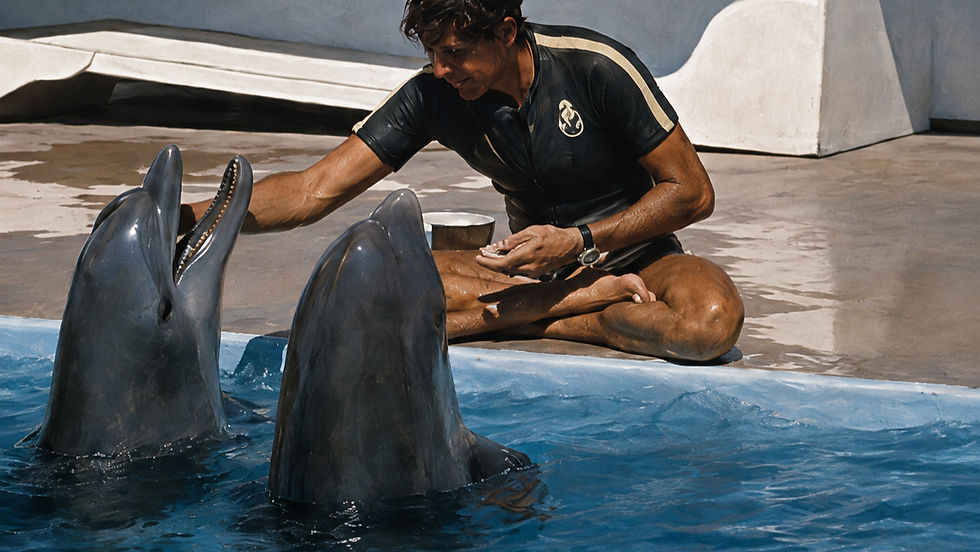
Anthony: Years later, you worked at an aquarium in Miami and developed a relationship with a dolphin named Clown. What did she teach you?
Jacques: Clown taught me that most humans enter the water with too much effort.
I first met her in 1957 at the Miami Seaquarium. She was intelligent, playful and one of the stars of the aquarium.
But what fascinated me was not that she could perform tricks.
It was the way she moved.
We kick too much. We tense muscles that don't help us. Even when we believe we are relaxed, we are often trying to control everything.
A dolphin does not negotiate with the water. It moves with it.
I watched Clown for hours. She could accelerate, stop, turn and play without appearing to struggle.
I began to ask myself whether the problem was not that humans were incapable of moving comfortably underwater, but that we had forgotten how to become comfortable there.
Anthony: So you tried to imitate her?
Jacques: As much as a human can imitate a dolphin, yes. Which is to say, imperfectly.
I was not trying to grow fins. I was trying to understand the quality of her movement and the absence of unnecessary tension.
People like to say that Clown taught me to hold my breath. Perhaps. But more importantly, she taught me not to waste it.
Anthony: That is a useful distinction.
Jacques: It is everything. A longer breath-hold is not only about having more oxygen. It is about requiring less.
Why Freediving Is Not a Fight Against the Body
Anthony: Many beginners approach freediving as a battle. They fight the urge to breathe, fight the pressure, and fight their fear. What would you tell them?
Jacques: That the body is not their enemy.
If you treat every sensation as something to defeat, you create more tension. If you create more tension, you consume more oxygen. If you consume more oxygen, the dive becomes more difficult.
Then you believe you must fight even harder.
It is a very efficient way to make yourself miserable.
Anthony: But some sensations are uncomfortable. Contractions, for example.
Jacques: Of course. I am not saying that discomfort disappears because you smile at it. I am saying that discomfort and panic are not the same thing.
A contraction is information. Pressure is information. The impulse to breathe is information.
The question is whether you can receive that information without immediately adding fear.
Anthony: So mental control is not about pretending that nothing is happening.
Jacques: No. It is about seeing what is happening clearly.
The diver who says, “I feel nothing,” may simply be disconnected. The diver who says, “I feel this, I understand it, and I remain calm,” is in a much better position.
When Scientists Thought the Human Body Could Not Go Deeper
Anthony: When you began pushing depth records, there were serious concerns that the lungs could not tolerate the pressure. What were people telling you?
Jacques: That there had to be a limit.
And of course, there is always a limit. The question was whether people understood where it was.
At the time, the lungs were often treated as if they were rigid containers that would simply collapse once they were compressed beyond a certain volume. The calculations appeared logical.
But the divers kept returning from depths that those calculations suggested should be impossible.
Anthony: So the problem was not the mathematics. It was the model.
Jacques: Exactly. The mathematics described part of the situation, but not the entire organism.
The body is not a bottle.
Blood can redistribute. The chest and lungs can adapt. The cardiovascular system responds to immersion and pressure. A human being is not simply a pair of lungs being squeezed by the sea.
Anthony: Today, we talk about blood shift and the mammalian diving response.
Jacques: Yes, although understanding the names of those mechanisms is not the same as mastering them.
What fascinated me was that the body seemed to have responses waiting for the right circumstances to emerge.
The ocean was not only applying pressure to us. It was also revealing something about us.
The Rivalry With Enzo Maiorca
Anthony: We cannot talk about your career without mentioning Enzo Maiorca. Were you really rivals?
Jacques: Of course we were rivals. We were also human beings, which is considerably more complicated.
Enzo was intense. He had tremendous determination. He wanted to push, to challenge, to prove what could be done.
We were different in temperament, but we were asking the same question: how deep can a human being go?
Anthony: Did you like each other?
Jacques: Sometimes.

Anthony: That is a very honest answer.
Jacques: Rivalry is rarely as simple as admiration or hatred. You can respect someone, disagree with him, compete against him and occasionally wish he would stop breaking records.
But without Enzo, I do not know whether I would have pushed as far. And perhaps the same was true in the other direction.
Anthony: The film presents your rivalry as almost theatrical.
Jacques: Cinema prefers clear characters. One man is passionate, the other mysterious. One fights the sea, the other disappears into it.
Real life is not so tidy.
Enzo loved the ocean. I could be competitive. We were both more complex than the versions of us that appeared on screen.
Robert Croft, Whisky and a Cigar
Anthony: Enzo was not the only freediver pushing the limits. There was also Robert Croft.
Jacques: Bob was remarkable.
Anthony: And apparently rather different from you when it came to preparation.
Jacques: That is one way to describe it.
I remember visiting him before a record attempt. I expected to find him resting and preparing himself mentally.
Instead, he was drinking whisky and smoking a cigar.
Anthony: The night before a record dive?
Jacques: Yes.
I told him he should be sleeping. I was practicing yoga, working on my breathing and trying to prepare with as much discipline as possible.
Bob appeared to have chosen a slightly different system.

Anthony: Did he explain it?
Jacques: I do not remember needing an explanation. The cigar was already quite clear.
Anthony: And yet he was an exceptional freediver.
Jacques: Yes, which is a useful reminder that human beings do not always follow the neat theories we create for them.
Different divers have different strengths.
Anthony: So you are not recommending whisky and cigars as part of a deep-diving protocol?
Jacques: No. Although it might make for an interesting chapter in a very irresponsible training manual.
The Preparation Behind the 100-Metre Dive
Anthony: People sometimes imagine your deepest dives as the result of meditation and an almost mystical relationship with the sea. But your preparation was much more organized than that, wasn't it?
Jacques: Considerably more organized.
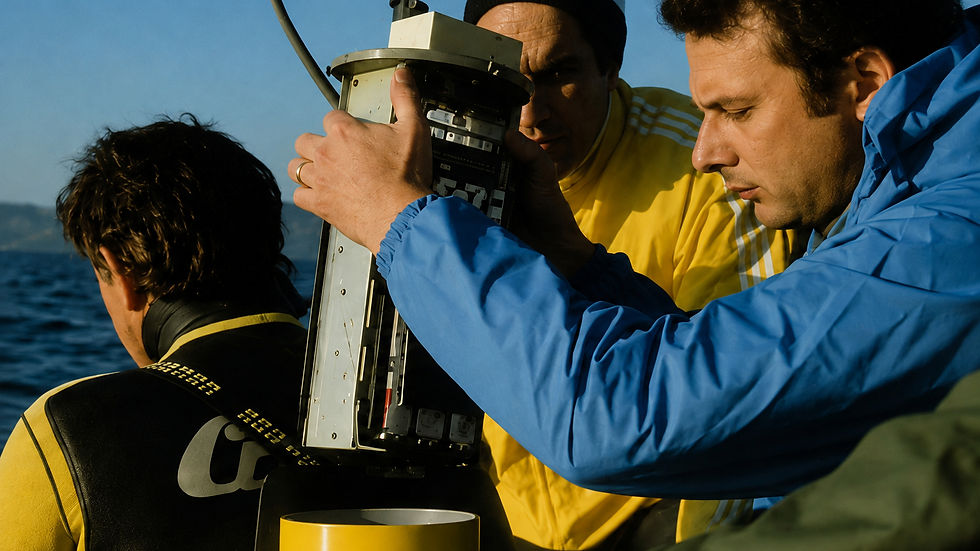
I worked with researchers, doctors and technicians. We wanted to understand what was happening to the body as pressure increased.
Some of the experiments involved underwater imaging, including early attempts to observe the body using X-ray equipment.

Anthony: So you were not simply trying to break a record. You were also participating in physiological research.
Jacques: Yes. We were asking questions that did not yet have clear answers.
How did the lungs respond? What happened to circulation? How did the heart behave? How far could the body adapt?
Anthony: You also trained at altitude.
Jacques: I did. The idea was to encourage the body to produce more red blood cells, then return to the sea and continue the diving preparation.
I alternated time in the mountains with long training periods in the water.
Anthony: That sounds very different from the idea that you simply sat on a platform, meditated and descended to 100 metres.
Jacques: The story becomes more romantic when you remove the difficult work.
But the difficult work was there.
Anthony: So yoga and meditation were important, but they did not replace physical training.
Jacques: Of course not.
You cannot meditate your way out of bad preparation.
Crossing the 100-Metre Barrier
Anthony: Take me back to November 1976. You are preparing to dive beyond 100 metres. What is going through your mind?
Jacques: Less than people might imagine.
Before a deep dive, the mind can become crowded very easily. There are expectations, cameras, doctors, assistants and people asking whether you are afraid.
But once you decide to dive, those things become distractions.
I needed to become quiet.
Anthony: Were you afraid?
Jacques: I respected the dive. Fear and respect are related, but they are not identical.
Fear becomes dangerous when it makes your body rigid or your decisions impulsive. Respect keeps you aware of what is at stake.
If I had told you I felt nothing, I would have been lying.
Anthony: What did 100 metres represent to you?
Jacques: A number, first of all. Human beings love round numbers.
But it also represented a boundary that people had invested with enormous meaning. Crossing it suggested that our understanding of the body was incomplete.
What interested me was not proving that I was stronger than everyone else. It was demonstrating that the human body might be more adaptable than we had assumed.
Anthony: And when you reached the bottom?
Jacques: There is a moment at depth when everything becomes very simple.
The surface is far away. The conversations are gone. There is only the water, the line, the pressure and the awareness that you must return.
People imagine deep diving as a dramatic confrontation. Sometimes it is. But often, the most striking thing is the absence of drama.
You have prepared. You have descended. Now you turn.
The depth does not applaud you.
Why His Record Was Not Constant Weight
Anthony: Let us clarify something for readers. You were not swimming down to 100 metres and back up under your own power.
Jacques: No. I used a weighted descent system and assistance for the ascent.
Anthony: What we would now associate with No Limits.
Jacques: Yes, although the sport and its categories have evolved considerably since my time.
Anthony: Some people might hear that and think it makes the dive less impressive.
Jacques: It makes it different.
If you descend using a sled, you reduce the muscular effort required to reach depth. That changes the oxygen demand. But the pressure does not care how you arrived.
You still have to equalize. You still have to tolerate the compression. You still have to manage the physiological consequences of a rapid descent and ascent.
Every discipline presents its own problems.
I would never claim that a sled-assisted dive is the same as swimming 100 metres without fins. That would be absurd.
But historical achievements must be understood within the context of their time.
Anthony: And at the time, the central question was whether a human being could survive the pressure at all.
Jacques: Exactly.

What Happened to His Heart Rate at Depth
Anthony: Researchers monitored your physiology during some dives. What did those measurements reveal?
Jacques: That my body was responding to immersion in ways that many people associated more readily with marine mammals.
The heart rate decreased. Blood circulation changed. The body appeared to prioritize the organs that needed protection.
Anthony: The diving response.
Jacques: Yes. Although I would be careful with the idea that this response makes us invincible.
People hear about a slow heart rate and begin imagining that the body has some unlimited reserve. It does not.
The diving response helps us manage the challenge of apnea and immersion. It does not remove the risks.
Anthony: That is an important point. Freedivers sometimes romanticize adaptation and forget that there are still limits.
Jacques: The ocean is very good at correcting romantic ideas.
Anthony: Did you feel your heart slowing?
Jacques: Not in the way one might feel a watch ticking. But you can become aware of a change in your overall state. Everything becomes quieter. The body feels less interested in unnecessary activity.
It is not magic. It is physiology.
But physiology can still feel extraordinary when you experience it from the inside.
Yoga, Breathing and the Art of Doing Less
Anthony: You practiced yoga and meditation long before they became normal parts of freediving education. Why?
Jacques: Because the mind and body are not separate passengers.
If the mind is agitated, the body responds. If the body is tense, the mind becomes more restless. Breathing connects the two.
Yoga helped me become aware of tension. Meditation helped me observe my thoughts without following every one of them.
These practices did not give me supernatural abilities. They helped me stop interfering with my own physiology.

Anthony: That sounds very different from the modern obsession with finding the perfect breathing routine.
Jacques: A routine can be useful. But if you become anxious because you didn't complete every breath exactly as planned, the routine no longer helps you.
Anthony: I see that frequently. Divers become dependent on a complicated preparation, and if anything changes, they panic.
Jacques: Then the preparation has become another source of tension.
The purpose of preparation is not to create a ritual that controls you. It is to arrive at the dive in a state that allows you to respond calmly.
Anthony: So the question is not, “What is the perfect breathing pattern?”
Jacques: No. The question is, “What helps me become quiet without creating another problem?”
The Woman He Lost
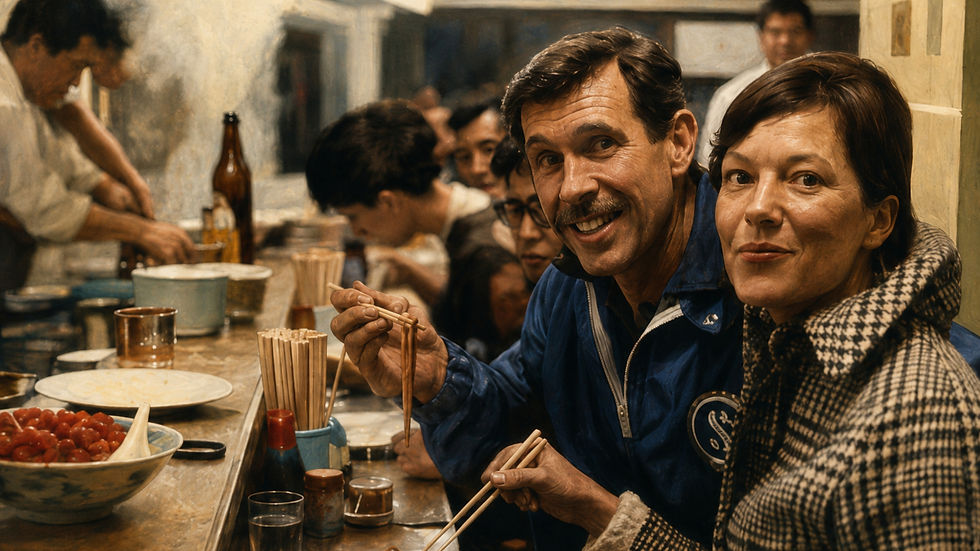
Anthony: I want to ask you about Gerda.
Jacques: That is more difficult.
Anthony: People close to you described her as someone who understood your way of living.
Jacques: She did.
She loved animals. She valued freedom. She was comfortable with simplicity.
We had created a life that, for once, did not feel like something I needed to escape.
Anthony: She died after being attacked by a stranger.
Jacques: Yes.
Anthony: Your friends said you rarely spoke about her afterward.
Jacques: Some experiences do not become easier when you describe them.
People imagine that grief always asks to be shared. Sometimes it makes you silent.
Anthony: Did losing her change your relationship with the ocean?
Jacques: It changed my relationship with everything.
The sea remained beautiful. That was almost the problem.
The world continues. Light still moves through the water. Dolphins still swim. Other people go on with their lives.
You look at all of it and wonder how everything can remain so unchanged when something essential has disappeared.
Anthony: Did diving help?
Jacques: Sometimes.
But the ocean cannot replace a person.
It can give you silence. It cannot answer every question.
Zen and the Problem of Thinking Too Much
Anthony: After Gerda’s death, you spent time in Japan and studied Zen.
Jacques: I stayed at a temple and learned from a Buddhist teacher.
He noticed that my mind was often occupied.
Anthony: Occupied by grief?
Jacques: By grief, memory, worry. By the endless movement of thought.
He would tell me not to think.
Anthony: That sounds easier said than done.
Jacques: Especially when the instruction was sometimes reinforced with a stick across the shoulders.
Anthony: Effective?
Jacques: Memorable.

Anthony: What did Zen give you?
Jacques: Simplicity.
Not the absence of problems. Not the disappearance of grief.
Just the possibility of allowing a thought to pass without following it everywhere.
Anthony: How did that connect with freediving?
Jacques: When you descend, unnecessary thinking becomes expensive.
The mind starts asking questions.
What if I cannot equalize? What if I feel contractions too early? What if something goes wrong?
Some questions are useful before the dive. During the dive, many of them become noise.
Zen helped me understand the difference.
Anthony: So mental control is not about forcing the mind to become empty.
Jacques: No. It is about not becoming trapped by every thought that appears.
Between Two Humpback Whales
Anthony: Dolphins played an enormous role in your life, but you also had a remarkable encounter with humpback whales.
Jacques: Yes. I joined an expedition where we had the opportunity to observe them in the water.
Until then, I had spent far more time around dolphins than whales.
Anthony: And you found yourself between two humpbacks.
Jacques: Two animals moving around each other, apparently communicating and displaying courtship behavior.
They were enormous.
Anthony: That must have been intimidating.
Jacques: Intimidating is a reasonable word.
But what stayed with me was the sound.
When humpback whales vocalize, you do not simply hear them. You feel the vibrations through the water and through your body.
For a moment, it is as if you have entered a conversation without understanding a single word.
Anthony: Did you feel small?
Jacques: Of course.
But feeling small is not always unpleasant.
Sometimes it is a relief to realize the world doesn't revolve around you.
Anthony: What did that experience teach you?
Jacques: That humans tend to imagine intelligence, communication, and emotional complexity as things that belong mainly to us.
The ocean is full of reminders that we are not nearly as central as we like to believe.
Are Humans Really Aquatic?
Anthony: Your book Homo Delphinus explored the idea that humans have a deeper connection to the ocean than we usually recognize. What did you mean?
Jacques: I believed that human beings had become disconnected from an important part of themselves.
We live surrounded by machines, schedules, artificial environments and constant noise. Then we enter the sea, hold our breath and discover that the body responds in ways we rarely experience on land.
The heart slows. The senses change. Time feels different.
I called this possibility Homo delphinus.
Anthony: But you were not suggesting that humans are literally dolphins.
Jacques: Fortunately not. Dolphins would probably object.
I was describing a potential relationship between human beings and the ocean.
Some of my ideas were philosophical. Some were speculative. I was not always trying to present a scientific theory in the modern academic sense.
Anthony: That distinction matters. The mammalian diving response is well documented, but the idea that humans evolved from an aquatic phase is not an established scientific conclusion.
Jacques: Precisely. We should not confuse poetry with evidence.
But we should not assume that poetry has no value simply because it is not a laboratory result.
What He Thought of The Big Blue
Anthony: Let us talk about The Big Blue. What was it like to see your life transformed into a film?
Jacques: Strange.
Imagine watching someone take fragments of your experiences, rearrange them, add music, invent conversations and then present the result to millions of people.
Some moments feel familiar. Others have almost nothing to do with your life.

Anthony: Jean-Marc Barr played the character inspired by you, and Jean Reno played Enzo.
Jacques: Yes. And cinema gave the public a version of freediving that was mysterious and beautiful.
For that, I am grateful.
But the film also encouraged people to believe that freediving is primarily about escaping human life or disappearing into the ocean.
That is a seductive idea. It is also dangerous if taken too seriously.
Anthony: Because freediving requires discipline, awareness and safety.
Jacques: Exactly. A diver who wishes to become part of the sea must also know how to return from it.
Anthony: The fictional Enzo dies in the film, but the real Enzo lived until 2016.
Jacques: Which I imagine he appreciated.
What He Would Think of Modern Freediving and Training
Anthony: If you could see freediving today, with athletes reaching extraordinary depths in constant weight, free immersion and no fins, what would surprise you most?
Jacques: Probably how much knowledge has become available.
When we were diving, much of what we did was experimental. We learned through observation, intuition and occasionally through mistakes.
Today, divers understand physiology, equalization, training, recovery and safety in ways we could only have imagined.
I would also be fascinated by athletes reaching such depths without mechanical assistance. The technical skill involved is remarkable.
Anthony: Freedivers now train CO₂ tolerance, hypoxia resistance, strength, equalization, mobility and mental control. What would you make of that?
Jacques: I would welcome it. But knowledge can become another form of noise.
If a diver enters the water thinking about ten physiological mechanisms, three training systems and a graph on a watch, there may be no space left to experience the dive.
Anthony: So the challenge is to train scientifically without becoming trapped inside the analysis.
Jacques: Exactly.
Learn the physiology. Practice the technique. Prepare carefully.
Then, when it is time to dive, let the preparation do its work.
You do not need to recite the definition of bradycardia while descending.
Anthony: I hope not. That would make equalization difficult.
Jacques: Especially if you are speaking out loud.
Anthony: But you did not always look kindly on competitive freediving. At the 1998 AIDA World Championships in Sardinia, you reportedly criticized the direction the sport was taking.
Jacques: I had concerns about what happened when the number became more important than the experience.
Anthony: According to people who were there, you expressed those concerns rather forcefully.
Jacques: I was not always known for expressing myself gently.
Anthony: Some people felt you were telling them they had misunderstood freediving entirely.
Jacques: Perhaps I was. Or perhaps I believed too strongly that my relationship with the sea should also be theirs.
Anthony: That sounds like a difficult position for someone who spent years breaking world records.
Jacques: Of course it does.
I pursued records. I competed. I cared about going deeper.
It would be dishonest to pretend otherwise.
But I wanted the depth to reveal something about the human body and our relationship with the ocean. I worried that competition could reduce that experience to rankings, medals and numbers.
Anthony: Still, competition does not necessarily prevent someone from having a meaningful relationship with the water.
Jacques: No, it does not.
And perhaps I was sometimes too quick to assume that other divers could not find meaning through a path different from mine.
The problem is not competition itself.
The problem begins when the result becomes the only reason to dive.
Anthony: That is something I discuss frequently with my students. If you do not understand why you are doing a dive, the depth becomes meaningless.
Jacques: A diver reaches 40 metres and immediately thinks about 50. Then 60. Then 70.
At what point does the diver actually experience 40 metres?
Anthony: So progress is not always a bigger number.
Jacques: A deeper dive is not automatically a better dive.
Sometimes the most important progress occurs when a diver repeats the same depth with less tension, cleaner technique and greater awareness.
From the surface, the number looks unchanged.
Inside the dive, everything has changed.
Age, Experience and the Limits of Talent
Anthony: You reached 105 metres at 56. That is not the age most people associate with peak athletic performance.
Jacques: Freediving is not only about producing maximum power.
Experience matters. Relaxation matters. Familiarity with the body matters. The ability to avoid unnecessary effort matters.
These qualities can continue developing long after other athletic abilities begin to decline.
Anthony: So age is not necessarily the central limitation.
Jacques: Not always.
But we must also be realistic. Recovery changes. The body changes. Health matters.
The point is not that age is irrelevant. The point is that freediving rewards more than youth.
Anthony: What about natural talent?
Jacques: Natural ability exists. Some people adapt more quickly. Some have physical characteristics that help them.
But talent without patience is dangerous.
I would rather dive with someone who progresses slowly, understands their limitations and respects safety than someone with extraordinary abilities who believes the rules do not apply to them.
What He Would Tell Someone Preparing for a Deep Dive
Anthony: Modern freediving has better safety systems than those available during your era, but accidents still happen. What would you say to divers who romanticize risk?
Jacques: That the ocean does not distinguish between courage and poor judgment.
A beautiful idea does not protect you from hypoxia. Confidence does not replace a trained safety diver. Experience does not make you immune to mistakes.
If you are taking significant risks because you want to prove that you belong in the water, you may have misunderstood the relationship.
Anthony: So respecting the ocean also means respecting procedures.
Jacques: Yes. Safety is not opposed to freedom.
It is what allows you to continue experiencing it.
Anthony: Imagine someone is preparing for their first serious deep dive. They have trained, the safety is organized, but they are nervous. What would you tell them?
Jacques: That nervousness is not a failure.
The important thing is not to eliminate every uncomfortable thought. It is to avoid becoming controlled by those thoughts.
Focus on what you can do.
Prepare carefully. Breathe normally. Equalize early. Move efficiently. Pay attention to the line. Respect the turnaround depth.
And remember that the surface is part of the dive.
Anthony: That last point is essential.
Jacques: The dive does not end at the bottom. It ends when you return safely and have fully recovered.
Anthony: Would you tell them to relax?
Jacques: Everyone tells divers to relax.
I would ask a more useful question: “What are you doing right now that you do not need to do?”
Perhaps the jaw is tight. Perhaps the hands are gripping too hard. Perhaps the mind is rehearsing failure.
Relaxation is often not something you add.
It is what remains when you remove unnecessary effort.
Was the Depth Ever Really the Point?
Anthony: If you look back at your life, what mattered more: the records or the relationship you developed with the ocean?
Jacques: The records opened doors. They attracted attention and encouraged scientific questions.
But numbers are temporary.
Someone always goes deeper.
If my work had any lasting value, I hope it was in helping people see that freediving can be more than a contest.
It can be a way to understand the body, quiet the mind, and reconsider our relationship with the natural world.
Anthony: So what would you want people to remember?
Jacques: That we do not need to conquer the ocean to learn from it.
And perhaps that the most important journey is not always the one measured in meters.
Anthony: What is it measured in, then?
Jacques: Attention.
The ability to notice where you are, what your body is doing and how extraordinary it is to be there at all.
Anthony: One final question. If you could dive again, where would you go?
Jacques: Somewhere quiet.
No cameras. No record. No one waiting for a number.
Just a line disappearing into the blue.
And, if possible, a dolphin nearby.
Further Reading

Jacques Mayol spent his life exploring what happens when a human being leaves the surface and descends into the ocean on a single breath.
That same question has driven much of my own journey. For more than ten years, I have trained, taught, coached, experimented, made mistakes, changed my mind, and tried to understand not only how we can dive deeper, but why our training works.
I wrote The Depth Collector to bring everything I learned together: the science, the training methods, the personal experiences, and the practical tools I wish I had when I began freediving.
If this interview made you curious about what your body and mind can truly learn to do underwater, I continue the exploration here.


Comments